
Question and scope
For this recording, what spike activity appears near isolated twitches of different body parts? How stable are the candidate response and preferred-body-part labels when the peak search window is narrowed?
The analysis shown here covers P12, pup 1, and 21 units labeled “good” in the ventral posterior (VP) thalamic spike-time data. It does not support conclusions about other pups or ages by itself.
Work completed
- Inspected the MATLAB behavior and spike-time files with Python, NumPy, and SciPy; confirmed the required files and fields load.
- Identified movement timestamps for RFL, RHL, tail, and whisker, and counted 21 “good” VP units in this recording.
- Selected isolated twitches for the working analysis and calculated movement-aligned activity summaries.
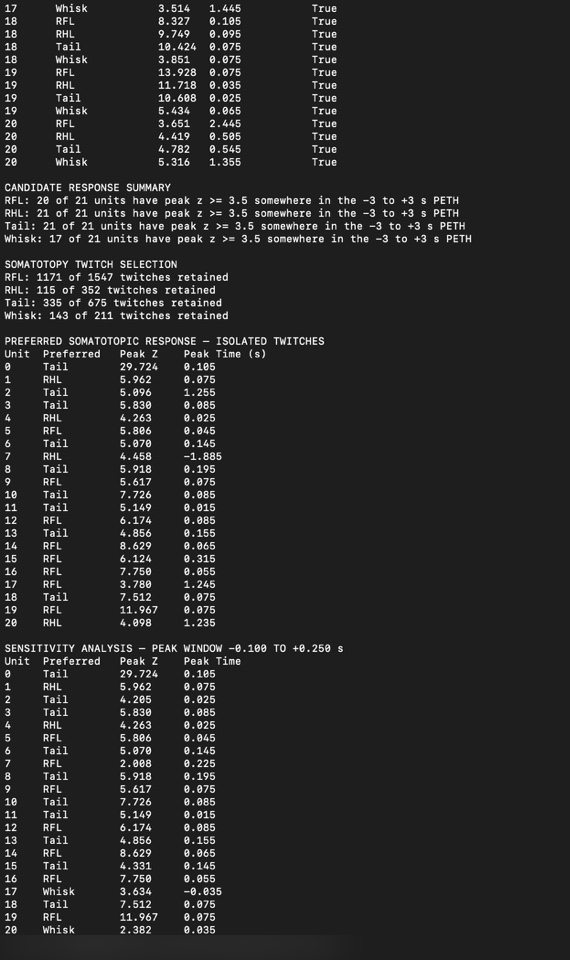
- Compared a broad ±3-second candidate search with a narrower −0.100 to +0.250-second peak window.
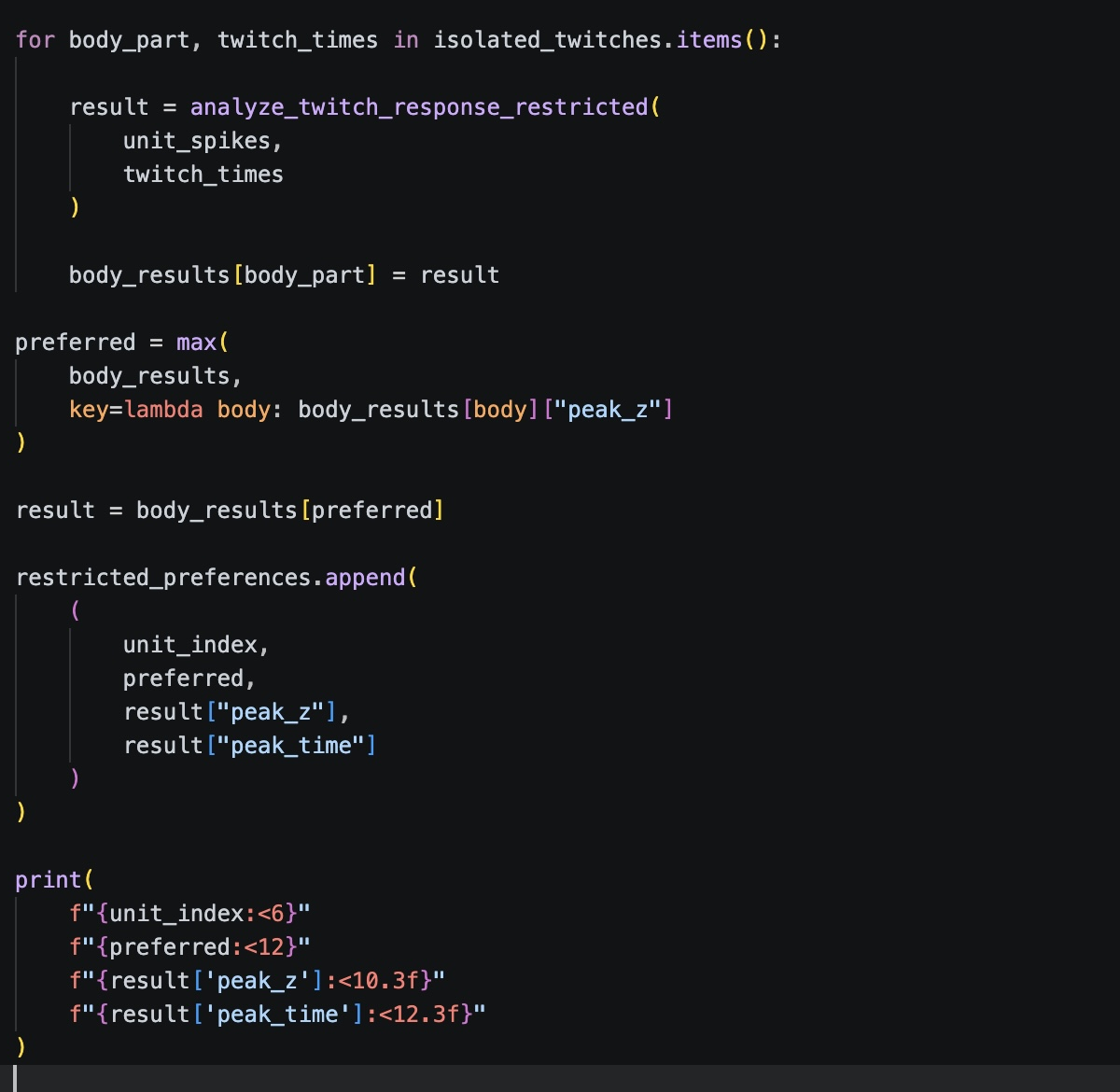
The exact isolation, baseline, binning, and z-score rules still need a code-level audit before this method is treated as final.
Exploratory output
In the broad −3 to +3 second peri-event time histogram window, the current script reports a peak z-score of at least 3.5 somewhere in that window for the following numbers of units:
| Movement | Units crossing screen | Total units |
|---|---|---|
| RFL | 20 | 21 |
| RHL | 21 | 21 |
| Tail | 21 | 21 |
| Whisker | 17 | 21 |
Interpretation limit: These counts are a screen over a wide window, not proof of twitch-specific responses or a test of selectivity. The narrower peak-window output changes some preferred-body-part labels; those differences must be investigated, not hidden.
Analysis screenshots
These excerpts document the working output and the code used to select preferred responses. The terminal’s local computer prompt is blurred, and both screenshots are cropped to the relevant material. The visible results and code have not been redrawn or edited.
Checks before a result claim
- Compare the working script step by step with the published method and document any differences.
- Freeze and report the isolated-twitch, baseline, bin-width, response-window, and z-score definitions.
- Inspect movement-aligned plots and event counts for each body part, including possible overlap or timing artifacts.
- Repeat the analysis across the other available pups and ages; report all outcomes, including null or inconsistent ones.
- Share a reviewed script and enough processing detail for another person to reproduce the tables.
Source material
This work examines data associated with Dooley, Sokoloff, and Blumberg’s 2021 study. The observations above are from LX5’s exploratory script, not numbers claimed by the authors.
- Dooley, Sokoloff & Blumberg (2021), “Movements during sleep reveal the developmental emergence of a cerebellar-dependent internal model in motor thalamus” — original article.
- Associated Dryad dataset — spiking and movement timecodes and displacement data.
- Authors’ analysis code — reference for method comparison.